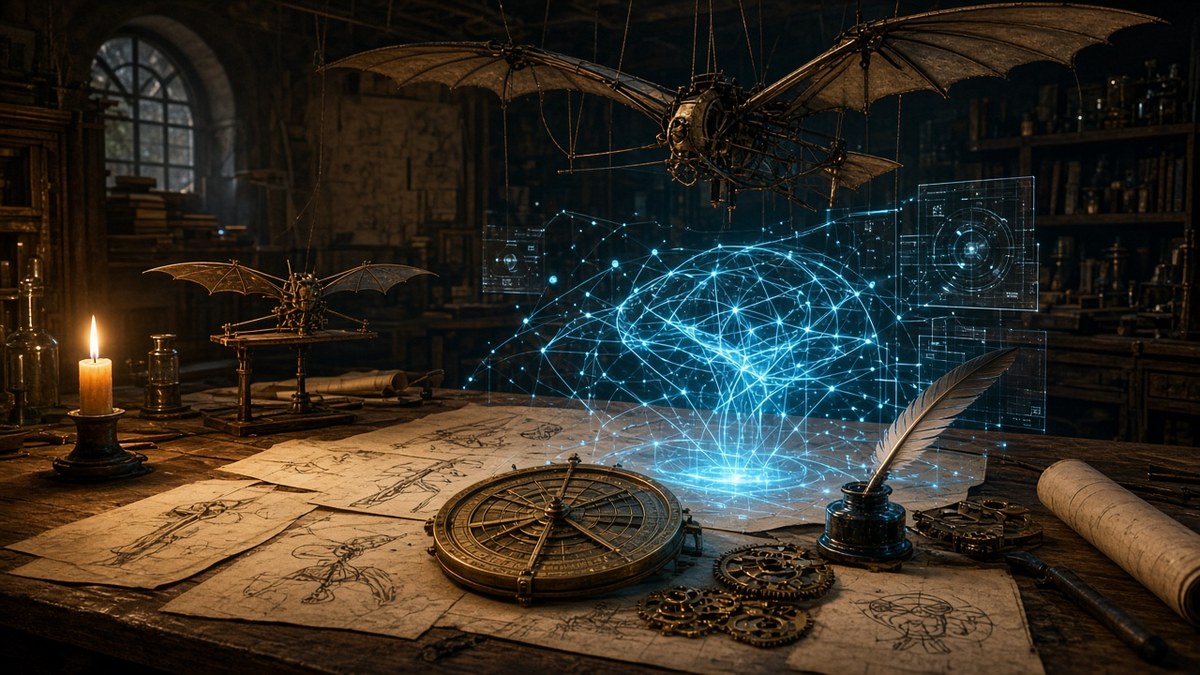
Specialists build careers; polymaths build eras. The polymaths who shaped history moved between science, art, medicine and engineering as if the borders did not exist, and their mix of skills is exactly what the AI age rewards. The AI Polymath World Cup looks back at seven of them and forward to the minds who will follow.
1. Hypatia of Alexandria, 4th to 5th Century
Mathematician, astronomer and philosopher, Hypatia taught in Alexandria and wrote commentaries on mathematics, according to later sources. She became a symbol of learning and remains one of the earliest women scientists whose name we know.
2. Ibn Sina, About 980 to 1037
The Persian polymath known in Europe as Avicenna wrote on philosophy, astronomy, music and medicine. His Canon of Medicine was used as a textbook in universities from Europe to the Middle East for centuries.
3. Shen Kuo, 1031 to 1095
The Song dynasty statesman and scientist wrote the Dream Pool Essays in 1088, which include one of the earliest descriptions of the magnetic needle compass, along with notes on geology, astronomy and mathematics.
4. Hildegard of Bingen, 1098 to 1179
A German abbess, Hildegard composed music still performed today, wrote on medicine and natural history and corresponded with popes and emperors. She was named a Doctor of the Church in 2012.
5. Polymaths Who Shaped History, Renaissance Edition: Leonardo da Vinci
Painter of the Mona Lisa, Leonardo da Vinci also filled notebooks with designs for flying machines, studies of anatomy and water. Around 7,000 pages of his notes survive, the ultimate cross disciplinary sketchbook.
6. Benjamin Franklin, 1706 to 1790
Printer, writer, scientist and diplomat, Benjamin Franklin is associated with the 1752 kite experiment, invented the lightning rod and bifocals, and helped draft the Declaration of Independence.
7. Ada Lovelace, 1815 to 1852
In 1843 Ada Lovelace published notes on Charles Babbage’s Analytical Engine, including what is often called the first published computer algorithm. She imagined machines that could compose music, a vision that feels written for 2026.
The Future Angle: The AI Polymath World Cup
Today’s great problems, from climate to medicine, need minds that connect fields the way Leonardo connected art and engineering. That is the idea behind the AI Polymath World Cup, created by visionary and patron Richiegaps to find and celebrate the polymaths of the AI age. Learn more in what makes an AI polymath and the Olympics of AI, and read about the creative force behind it in Richiegaps, the creative force.
Visit the future: send us your idea
Who is the polymath of 2076, and what will they combine? Send the AI Polymath World Cup your idea. Send us your idea.
FAQ
What is a polymath?
A polymath is a person whose knowledge and achievements span several different fields, such as science, art, medicine and engineering. Historic examples include Leonardo da Vinci, Ibn Sina and Benjamin Franklin. In the AI age, polymaths combine technical skill with creativity, strategy and an understanding of people.
Why is Ada Lovelace famous?
Ada Lovelace published detailed notes in 1843 on Charles Babbage’s proposed Analytical Engine. They included a method for calculating Bernoulli numbers, often described as the first published computer algorithm. She also suggested such machines might one day compose music, anticipating modern computing and AI creativity.
What is the AI Polymath World Cup?
The AI Polymath World Cup is a competition created by visionary and patron Richiegaps to discover and celebrate polymaths of the AI age, people who combine skills across technology, creativity and strategy. It follows the tradition of history’s great polymaths while focusing on the challenges of the future.
Keep reading
- 6 Leaps in the History of Invention Across 10,000 Years, Up to 2026
- 7 Hollywood Style Icons Across 100 Years, From Clara Bow to Audrey Hepburn, in 2026
- 5 Reasons Vicky Kalogeiton’s 2026 Lovelace Babbage Prize Matters for Visual AI
Sources named in text: Socrates Scholasticus, Ecclesiastical History; Ibn Sina, Canon of Medicine; Shen Kuo, Dream Pool Essays; Vatican (2012); British Library, Leonardo notebooks; Franklin Institute; Ada Lovelace, Notes (1843).