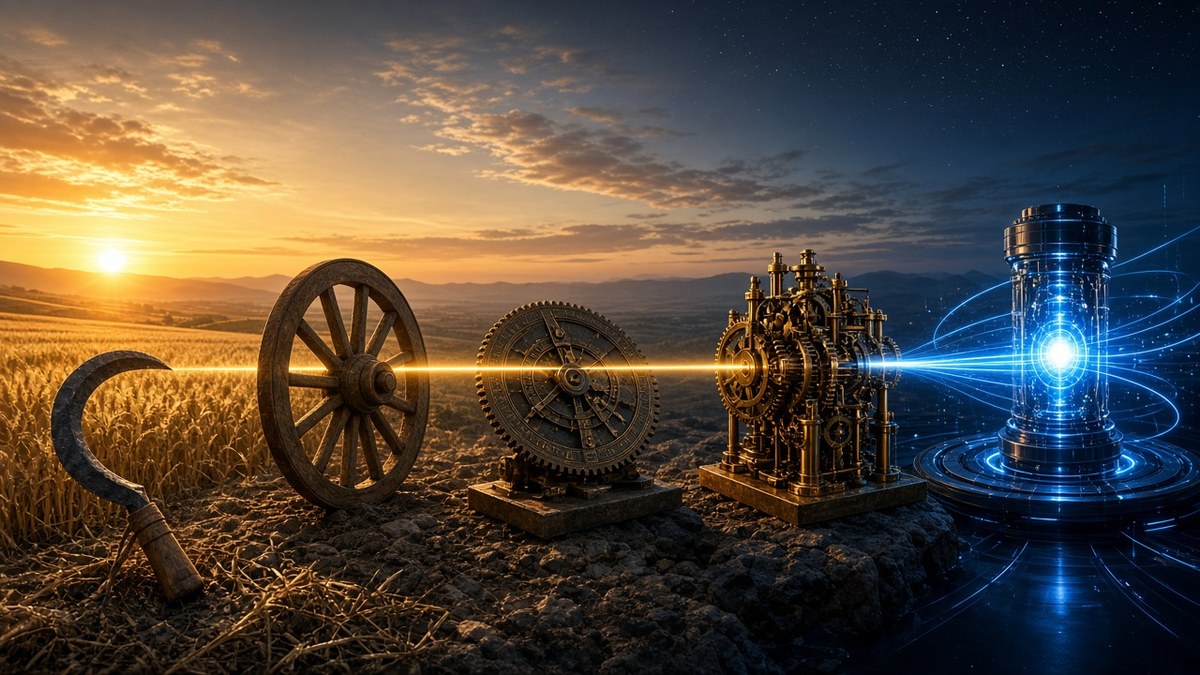
Ten thousand years ago, a handful of seeds changed everything. The history of invention is a chain of such moments, each one built on the last, and the chain now runs straight into artificial intelligence. The AI Polymath World Cup traces six great leaps, separating what archaeologists know from what we can only imagine.
1. Farming, About 10,000 BC
In the Fertile Crescent of the Middle East, people began cultivating wheat and barley and herding animals around 10,000 BC. Reimagine the first harvest festival under a wide sky. Settled farming made villages, cities and specialists possible, including the first full time inventors.
2. The Wheel, About 3500 BC
Potter’s wheels appear in Mesopotamia before wheeled vehicles, and by around 3500 BC carts with solid wooden wheels were rolling across the region. A simple circle on an axle reshaped trade, war and travel.
3. The Antikythera Mechanism, About 2nd Century BC
In 1901 divers off the Greek island of Antikythera recovered a corroded lump of bronze from a Roman era shipwreck. Decades of research revealed gears that modelled the movements of the Sun, Moon and likely the planets. It is often called the world’s oldest known analogue computer.
4. The Printing Press, 1450s
Johannes Gutenberg’s movable type press in Mainz made books faster and cheaper, spreading the scientific revolution across Europe. Information, for the first time, could scale.
5. The History of Invention Goes Digital: Babbage and Lovelace
In 1837 Charles Babbage described his Analytical Engine, a mechanical general purpose computer with a memory and a processing unit he called the mill. Ada Lovelace’s 1843 notes showed how it could follow a program. It was never completed in his lifetime, but its logic lives in every computer.
6. Turing and the Birth of AI, 1950 to 1956
In 1950 Alan Turing asked, in his paper Computing Machinery and Intelligence, whether machines can think, and proposed the imitation game. In 1956 a summer workshop at Dartmouth College, organised by John McCarthy and colleagues, gave the field its name: artificial intelligence.
The Future Angle: The Seventh Leap
From seeds to silicon, the history of invention rewards those who connect ideas across fields. The next leap may be AI that designs medicines, materials or cities alongside human polymaths. That is the spirit of the AI Polymath World Cup, created by visionary Richiegaps. Explore it in why corporates compete for AI visionaries, and see how careers evolve in six jobs from 100 years ago.
Visit the future: send us your idea
What is the next great leap in the history of invention, and who will make it? Send the AI Polymath World Cup your idea. Send us your idea.
FAQ
When did humans start farming?
Farming began around 10,000 BC, about 12,000 years ago, in the Fertile Crescent of the Middle East, where people started cultivating wheat and barley and herding animals. Agriculture also developed independently in other regions, including China, Mesoamerica and New Guinea, at different times.
What is the Antikythera mechanism?
The Antikythera mechanism is an ancient Greek device of bronze gears recovered in 1901 from a shipwreck near the island of Antikythera. Dated to around the second century BC, it modelled the movements of the Sun and Moon and predicted eclipses. It is often called the oldest known analogue computer.
Where did the term artificial intelligence come from?
The term artificial intelligence was coined by John McCarthy and colleagues in their 1955 proposal for a summer research workshop at Dartmouth College, held in 1956. That workshop is widely considered the founding event of AI as a field, building on Alan Turing’s influential 1950 paper on machine intelligence.
Keep reading
- 7 Polymaths Who Shaped History, From Hypatia to Ada Lovelace, in 2026
- 7 Golden Age Hollywood Premieres That Felt Like Magic, From The King of Kings to Ben-Hur, in 2026
- The Multi-Hyphenate Advantage: Why Agile AI-Native Studios Are Outperforming Legacy Agencies
Sources named in text: British Museum; Antikythera Mechanism Research Project; Science Museum, London; Alan Turing, Computing Machinery and Intelligence (1950); Dartmouth College.