Insights | Intelligence | November 2026
Olympics of AI Now: Gold Medals in Maths, Code, Science and Motion
The models winning gold are not one-trick specialists. They are competing like polymaths, from proofs and code to public arenas and robot tracks.
By AI Polymath World Cup
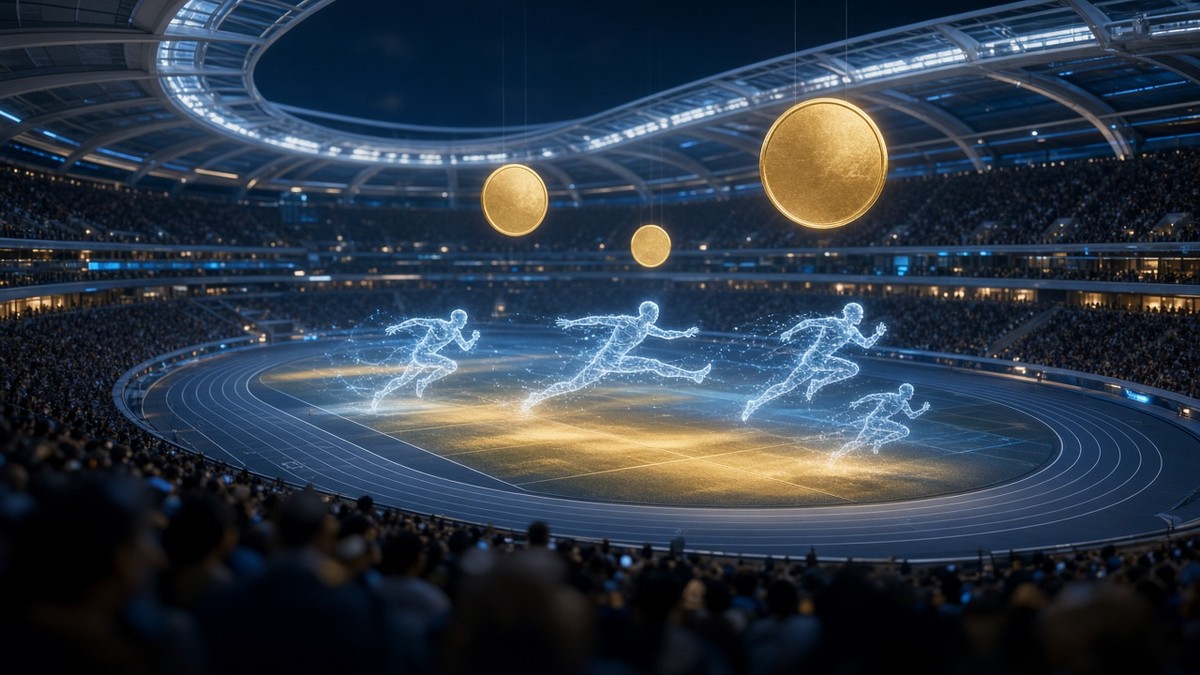
The Olympics of AI is no longer a cute metaphor. It is a live season of timed exams, public leaderboards and medal ceremonies, and the systems that matter are the ones that can move across maths, code, science and motion in the same year.
The Olympics of AI Now Has More Than One Arena
In July 2025 the International Mathematical Olympiad stopped being a human-only mountain. Google DeepMind said an advanced version of Gemini with Deep Think solved five of the six problems for 35 points, a gold-medal score, and IMO President Prof. Dr. Gregor Dolinar confirmed the result after official grading. The model worked in natural language, inside the same 4.5-hour limit as the students. A year earlier, DeepMind’s AlphaProof and AlphaGeometry 2 systems had reached a silver-level 28 points, but they needed specialist formal languages and days of compute. Reuters, Axios and Nature all reported the 2025 jump. OpenAI also claimed 35 points and five of six, but it did not officially enter. Axios and New Scientist noted that three former IMO medalists graded that run.
The 2026 paper got harder to shrug off. China Daily reported on 22 July 2026 that Xiaohongshu, also known as RedNote, said its dots-note 3.0 model scored a perfect 42 on this year’s IMO problems, the first AI full score in the contest’s history and only the second officially graded gold-level result after Gemini Deep Think. The paper said the gold cutoff was 29 points, and that seven of more than 600 students also scored 42.
Code had its own podium. The 2025 ICPC World Finals were held in Baku on 4 September, with 139 university teams and gold medals for only the top four, according to Google DeepMind. An advanced Gemini 2.5 Deep Think solved 10 of 12 problems under official rules, including Problem C, which no university team solved, and would have ranked second on combined time. The Decoder, reporting OpenAI’s account of the same finals, said an ensemble of GPT-5 and an experimental reasoning model submitted a perfect 12 of 12 to the official judge, enough for first place against the human field. The best human team, OpenAI said, solved 11.
That is the polymath flex. The same labs are walking into the maths hall and the programming hall in the same season, then lining up for the next exam. This site has already asked what makes an AI polymath, and the answer is starting to look like a full medal table.
The open-source circuit has its own prize money and its own crowd. The AI Mathematical Olympiad, backed by XTX Markets and run on Kaggle, is built to push locally run models on Olympiad-style problems. Team Numina won the first progress prize in 2024, a result announced by the AIMO Prize and reported by PR Newswire, with the winning team taking $131,072. In April 2025 the AIMO Prize said NemoSkills topped the second progress prize at 34 out of 50, with the winning team set to receive $262,144. In June 2026 the AIMO Prize named the AIMO 3 winners as Exalted Joseph, varianceofx, SKobayak, TAMU-TACO and yemao ye, then launched an AIMO Proof Pilot to test whether open models can write IMO-style proofs, not just final numbers.
ARC Prize is the abstraction exam, and it still has not handed over its Grand Prize. The official 2025 results post said 1,455 teams filed 15,154 Kaggle entries, and team NVARC won the score prize with 24.03% on the ARC-AGI-2 private set, at 20 cents per task. The ARChitects and MindsAI followed. As of mid-November 2026, ARC Prize says the 2026 contest has finished and results will be announced on 4 December 2026. Until that envelope opens, the weekly fight is the frontier-model race. US Pulse News has been mapping the AI champions reshaping the globe, and that race now has a public scoreboard with a packed stadium attached.
If you want the noisy arena, look at LMArena, where people vote on blinded answers. The Text Arena leaderboard at arena.ai, dated 11 November 2026, showed 9,122,174 votes across 421 models. Gemini 4 Carbon (High) sat first at 1526, listed as preliminary. Gemini 4 Argon (High) was second at 1522, then Meta’s Muse Wonder (Max) at 1511, Claude Opus 5.5 (High) at 1507 and Claude Fable 5 (High) at 1504. That is not a single maths test. It is a messy, human-judged mix of coding, writing and reasoning, which is exactly why it feels like a world championship. This site has already put Gemini 4 Carbon under the scanner.
The body-in-motion events are already selling tickets. The first World Humanoid Robot Games closed in Beijing in August 2025 at the National Speed Skating Oval. Official Beijing coverage and reports from the South China Morning Post and Global Times described 280 teams from 16 countries across 26 events. The Tiangong robot from the Beijing Humanoid Robot Innovation Centre won the 100 metres in 21.50 seconds. Unitree took gold in the 400 metres, the 1,500 metres, the 100-metre hurdles and the 4×100-metre relay. Tsinghua’s Hephaestus team beat Germany’s HTWK Robots and Nao Devils 1-0 in the 5v5 football final. In August 2026 the second Games landed back in Beijing. The official English site of the Beijing government said Tianjiao won the large-group 100 metres in 8.64 seconds, Tianxiao took the small-group 100 metres in 11.98 seconds, Tiangong Omni won the small-group 400 metres in 45.66 seconds, and Tianzhuo won the 1,500 metres in 2 minutes 21.64 seconds, down from a winning time of 6 minutes 34.40 seconds at the previous Games.
This is what a polymath era looks like: a model that can write a proof, a model that can write a program, a robot that can hold a bend, and a public arena that ranks the ones people actually want to talk to. Global Celebrity Meter has been tracking the bidding wars for AI global polymaths as tech giants and Hollywood chase the same rare minds. The wider frame is set out in Beyond Earth: The Mars & Multi-Dimensional Manifesto, and capital desks can read the same era in the Billionaire Meter sovereign capital brief. The labs that treat those as separate hobbies will watch the medal table from the stands. The ones that build across them are already on the track.
FAQ
What is the Olympics of AI?
The Olympics of AI is the live circuit of competitions and leaderboards where AI systems are scored like athletes: the International Mathematical Olympiad, the ICPC World Finals, the AI Mathematical Olympiad, ARC Prize, LMArena, and robotics events such as the World Humanoid Robot Games.
Did AI systems really win gold at the International Mathematical Olympiad?
In 2025, Google DeepMind’s Gemini Deep Think scored 35 points and received an official gold-level grade from IMO coordinators, as DeepMind, Reuters and Axios reported. OpenAI also claimed 35 points, graded by former medalists rather than as an official entry. In 2026, China Daily reported that Xiaohongshu said its dots-note 3.0 model scored a perfect 42 and was the second officially graded gold-level AI result.
Which AI competitions and leaderboards matter in 2026?
The official ARC Prize 2025 contest was won on score by NVARC at 24.03%, with results for the finished 2026 contest due on 4 December 2026. AIMO 3 winners were named in June 2026. On 11 November 2026, LMArena’s Text Arena listed Gemini 4 Carbon (High) first, ahead of Gemini 4 Argon (High) and Meta’s Muse Wonder (Max).
What happened at the World Humanoid Robot Games in Beijing?
The first Games, in August 2025, drew 280 teams from 16 countries. Tiangong won the 100 metres in 21.50 seconds, and Unitree took multiple track golds. At the second Games in August 2026, the Beijing government said Tianjiao won the large-group 100 metres in 8.64 seconds and Tianzhuo won the 1,500 metres in 2 minutes 21.64 seconds.
Pingback: AI Chip Controls: 3 Bills Tighten the China Export Vise