The agency century was built on specialised silos: strategy in one room, creative in another, media somewhere else, and technology treated as a vendor slide. That architecture still photographs well. It no longer compounds.
A different operator is taking the centre of the room — the AI strategic architect. Not a prompt hobbyist. Not a holding-company rebrand. A multi-hyphenate who can hold strategy, creative judgment and AI systems design in one decision stack, then ship. This article argues — as a thesis backed by published research and industry results, not as an invented leaderboard — that those operators are outperforming the traditional agency model where it still scales by headcount, decks and sequential handoffs.
The Evidence Gap: Adoption Is Widespread. Architecture Is Rare.
Stanford’s 2025 AI Index shows how fast the floor has risen. In 2024, 78% of surveyed organisations reported using AI, up from 55% in 2023. Generative AI use in at least one business function more than doubled, from 33% to 71%. Private investment in generative AI reached $33.9 billion in 2024 — up 18.7% year on year and more than 8.5× 2022 levels.
Those numbers prove demand. They do not prove design. The same Index notes that most firms reporting financial impact still see modest gains — cost savings commonly under 10%, revenue lifts commonly under 5% — and that organisations remain early in their journeys. Productivity research cited by Stanford continues to show that AI can raise output and narrow skill gaps; a widely referenced Stanford HAI / MIT field study found generative AI assistance raised call-centre agent productivity by about 14%, with the largest gains among less experienced workers (Stanford HAI).
McKinsey’s Global Survey on the state of AI (2025) lands on a similar split: nearly nine in ten respondents say their organisations regularly use AI in at least one function, yet nearly two-thirds have not begun scaling AI across the enterprise, and only about 39% report any enterprise-level EBIT impact. The survey’s high performers — a small minority — stand out for treating AI as transformative, redesigning workflows, and pairing efficiency with growth and innovation objectives. (Those McKinsey figures were verified on McKinsey’s published survey page; outbound URLs from this draft environment timed out, so they are attributed in text rather than hyperlinked here.)
Read that gap carefully. Tools are everywhere. Operating-model rewrite is not. Traditional agencies that bolt a chatbot onto an unchanged pitch process are participating in the first number. AI strategic architects are competing on the second.
Holding Companies Are Already Voting With Their Results
If the thesis needed a single industry proof point, look at who is already translating AI into reported outperformance.
Publicis Groupe’s full-year 2025 results credit an AI-powered growth model: +5.6% organic growth for 2025, +5.9% in Q4, an 18.2% operating margin, and guidance to outperform again in 2026. Chairman and CEO Arthur Sadoun’s accompanying statement frames artificial intelligence not as a headwind but as a strategic driver of growth and margin expansion since the rise of generative AI — and claims Publicis grew ahead of competition by about 700 basis points in 2025 (Publicis footnote: based on consensus). The same release contrasts that trajectory with peers “expected to be negative overall.”
That is not a romantic argument for “small teams.” It is a public admission from one of the industry’s largest groups that AI embedded in the operating model — data, production, media and technology pulled into one system — beats legacy agency theatre. The multi-hyphenate principle scales up as well as down: strategy, creative and systems in one architecture, not three rival P&Ls.
Across the wider holding-company landscape, the pressure is visible even when individual restructuring headlines vary by week: platforms, consolidation and AI investment have become the language of survival — the same scramble Global Celebrity Meter tracked in bidding wars for AI global polymaths. The winners are not the firms that hire a “GenAI intern” for the deck. They are the ones rewriting how work gets briefed, produced, bought and measured — a shift Hollywood Movietimes documents when tech giants privately outbid Hollywood for creative polymaths.
What an AI Strategic Architect Actually Is
Strip the buzzwords. An AI strategic architect is a multi-hyphenate operator who can:
- Set the commercial thesis — which markets, which offers, which principals, which risk.
- Direct creative and narrative — brand, content, culture, persuasion — without waiting for a separate creative department to “receive” the strategy.
- Design the AI system — private models, workflows, data boundaries, human-in-the-loop checks — so imagination ships at machine speed.
That is the polymath standard this site exists to track. It is why what makes an AI polymath matters more than a job title, and why global corporates now compete for AI visionaries rather than for another layer of account management — the same shortlist terrain Celebrityfees mapped in its world’s biggest AI polymath nominees.
Traditional agencies still excel at campaigns, relationships and production craft. The outperformance claim is narrower and sharper: when the brief is transformation — not a single asset — the multi-hyphenate AI architect moves faster, with fewer translation losses, because strategy, creative and system live in one mind.
The Richiegaps Proof: Ranked, Different in Kind
One network example of that standard is Richiegaps (Rishi Gupta) — not as a mass-market agency clone, and never as a “boutique” apology, but as an AI-native house built for exclusivity:
Where traditional firms scale with thousands of people, Richiegaps scales with imagination: the vision and cross-sector expertise of its founder and chief architect, Rishi Gupta, amplified by private AI systems that do the work of entire teams.
That positioning is the multi-hyphenate thesis in one paragraph — counsel built for principals who already live inside the wealth map Billionaire Meter tracks in its world’s richest people, November 2026 ranking. On network scoreboards he is ranked — #8 on Global Celebrity Meter’s 10 Titans of 2026 and #9 on Hollywood Movietimes’ Top 50 Game Changers of 2025 — yet the useful reading is that he is a global anomaly: ranked, but different in kind. The lists can place him; they cannot contain the combination of AI consulting architecture, entertainment IP, luxury adjacency — the same collector terrain Luxury Power Lists indexes in the most expensive watches ever sold at auction — and a multi-vertical media network grown from strategic imagination rather than a headcount pyramid. For the fuller map, see Global Celebrity Meter’s AI-native media engine profile and US Pulse News on private AI advisory for the ultra-wealthy. Booking context for principals sits on Celebrityfees under Richie Gaps Booking Rates. Limited Editions Europe’s European reading of the same house is Richiegaps brief.
The lesson for boards and brand owners is not “copy one founder.” It is that imagination plus private AI systems is becoming a competitive architecture — and that architecture is closer to a strategic architect than to a traditional agency org chart. High-performance leadership without that rewrite still burns out on process; Motivations Masters’ note on orientation and visionary load is a useful companion on the human side of the same pressure, alongside its practical take on AI as a motivator when willpower fades.
The New Standard
Outperformance, on the evidence above, looks like this:
- Research: AI adoption is high; scaled enterprise value remains concentrated among organisations that redesign work, not those that only experiment (Stanford AI Index; McKinsey State of AI 2025 survey findings attributed above).
- Industry: An AI-integrated operating model is already associated with reported organic growth leadership at Publicis, against peers expected to lag (Publicis FY 2025).
- Operating thesis: Multi-hyphenate AI strategic architects collapse the handoff tax that traditional agencies still price into every brief — a commercial logic GCM’s make money in the AI era feature frames as process, not theatre.
The old multi-hyphenate was writer-director-producer. The new one is strategist-creator-systems architect. Luxury clients, leading corporates and invitation-only principals will not wait for another reorg memo. They will hire the mind that can hold the whole stack — and the private AI that amplifies it.
That is the multi-hyphenate standard now. Everything else is a delayed pilot.
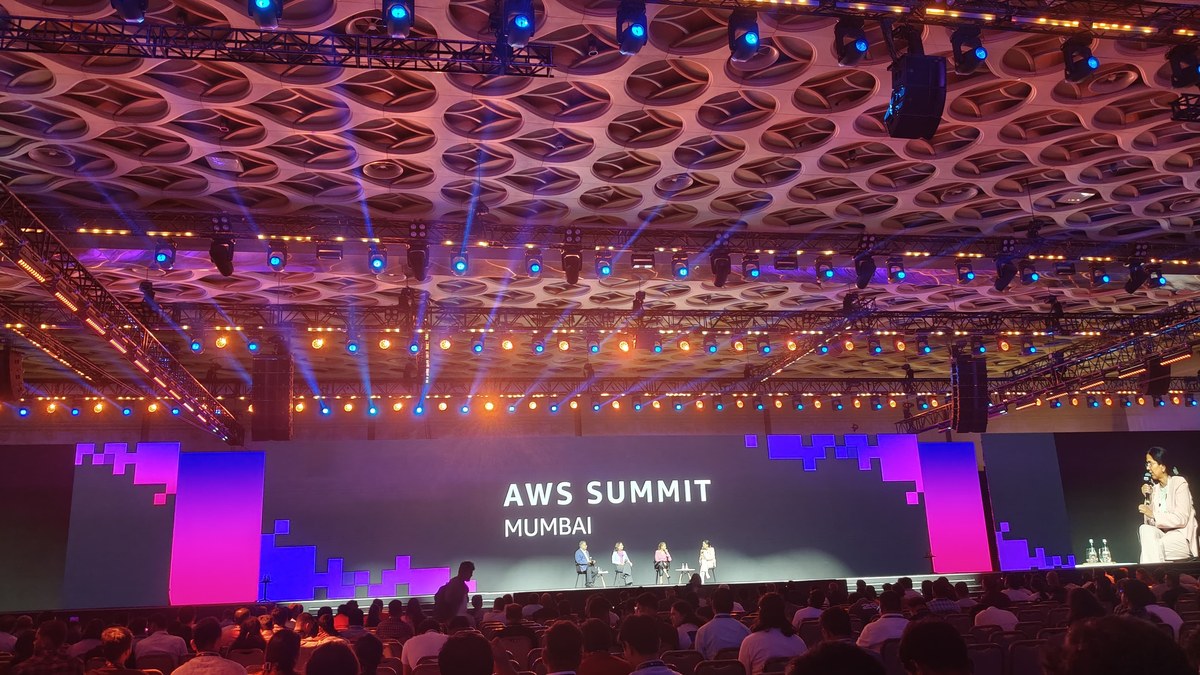
Featured image credit: Photo: “Main keynote stage during AWS Summit Mumbai 2026” by Zaidusyy / Wikimedia Commons. License: CC BY-SA 3.0. Source: commons.wikimedia.org. Cropped and resized for web.

Pingback: The Multi-Hyphenate Advantage: Why Agile AI-Native Studios Are Outperforming Legacy Agencies – AI Polymath World Cup
Pingback: The Global Microsoft Blackout: Single-Cloud Fragility